Walking along the streets of London or shopping for groceries, it is far from uncommon to come across a woman dressed in all black with her face hidden from the eyes of others. This is especially true about where I am currently staying as a good percentage of the residents here are Muslim. The face covering of some Muslim can be called several terms, however perhaps the most used term and the term that is often used to refer to covering ones face as a whole is niqab.
The niqab is considered part of what is known as hijab. Hijab has two definitions: 1) the specific head covering employed to cover the hair (which is what I was referring to yesterday) and 2) the general styles of modest dress worn by Muslims. Every Muslim is required to cover their awrah, the parts of the body that are not to be exposed to others. For women this includes everything except the hands and the face. Some, but not many, Islamic scholars also include the face into the definition of female awrah.
This is where the niqab comes in. The niqab is a piece of cloth that covers the face save for the forehead and eyes or just the eyes. Some niqabs come with an optional veil which covers the entire face which can be removed if necessary. Others are paired with a hijab and tied around the head. Then there are pieces of clothing such as the burqa that also cover the eyes with either a mesh section or a slightly see-through piece of cloth.
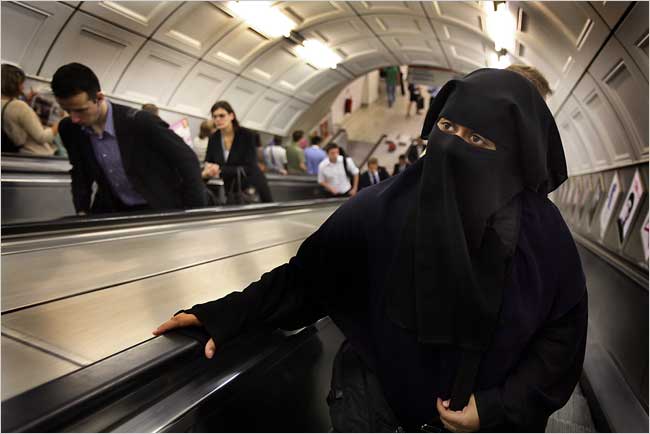
An example of a niqab.

Women wearing burqas.
My personal opinion is that the niqab is not compulsory like the hijab. I do not necessarily agree with the scholars who insist it is so. I imagine those who do believe it is compulsory and those who wear a niqab have their evidence and proof to explain their beliefs. Perhaps if that evidence was brought to me, I might change my mind.
However, if you remember yesterday’s post there is a hadith that outlines what a woman is expected to cover: Abu Dawood narrates that `Aishah said: “Asmaa' the daughter of Abu Bakr came to see the Messenger of Allah wearing a thin dress; so Allah's Messenger turned away from her and said, ‘O Asmaa', once a woman reaches the age of menstruation, no part of her body should be seen but this,’ and he pointed to his face and hands.”
But just because I don’t personally believe the niqab is compulsory, I don’t think I should not wear one. In fact, as I mentioned before, I have considered it in the past. This is because I think the niqab has several great benefits.
One answer to a question on the Yahoo! Answers points out these benefits very well in comparison to the hijab:
The hijab is a screen of privacy; the niqab is a better screen of privacy.
The hijab helps develop taqwa (consciousness of Allah); the niqab helps develop more taqwa.
The hijab is a jihad (personal struggle) that purifies the soul; the niqab is a greater jihad.
The hijab is a protection for sisters; the niqab is a better protection
The hijab is an assertion of Islamic identity; the niqab is a stronger assertion.
The niqab helps a sister stay in check. She would reflect upon her actions before falling into wrong insha’Allah. Also, it would be hard to forget Allah while wearing the niqab, and Muslims strive to remember Allah every waking moment. Remembrance of Allah has excellent benefits such as sustence for both the heart and soul, dispels worries, fills the heart and face with light, instills fear of Him, remedies hard hearts, and more.
One can see there are plenty of reasons why a sister would become a niqabi (one who wears a niqab). However, it is necessary to look at the negatives as well. At the top of the list is the fact that it’s hard to wear a niqab in Western countries.
Several countries in Europe have bans on niqabs, burqas, and other face coverings. Not more than a month ago the headlines were filled with mention of a ban going into effect in France. Muslim women are forbidden to cover their faces in public places. Some women have defied the ban only to be arrested and fined. Other countries with related bans include Belgium and Germany.
As for North America there haven’t been many niqab-related issues. In Canada, specifically Quebec, some women have run into trouble while wearing a niqab. One Muslim sister in Montreal was expelled from a francization school because she refused to abandon the niqab in class. Scholars who do uphold that the niqab is necessary sometimes give an exception to those living in West wear the niqab is not understood by the governments there.
Ultimately, I cannot say yet whether I can see myself wearing a niqab anytime soon. I am the type of Muslim who becomes more conservative and more fundamentalistic as time goes on. My beliefs from when I originally reverted compared to now are very different. So it is a good possibility that I will in the end wear a niqab. If I continue to live in the West, it might take longer to reach that point and I might never reach that point simply because it is tough to do there.
I’m still asking myself: should I wear a niqab? It is not an easy question to answer – at least not for me.
Salam alaykum wa Rahmat Allah wa barakatu,
ReplyDeleteI became a practicing Muslimah one year ago (Praise Allah!). I've recently made the intention to be a full-time Niqabi, insha Allah ta'ala. Here's a helpful website to tell about the face cover during the time of the Prophet (Peace be upon him).
http://www.seekingilm.com/seekingilms-research/niqab
Insha Allah ta'ala this will be helpful to you.
Wa alaykum is-Salam wa Rahmat Allah wa barakatu.
Wa alaykum assalam wa rahmatullahi wa barakatuh! Mashallah welcome to Islam dear sister! May Allah protect you and keep you on the right path! Ameen! Jazakallah khair for the link…I will certainly check it out insha’Allah. Fee amanillah!
ReplyDeleteQuestioning the Veil: Open Letters to Muslim Women: http://press.princeton.edu/titles/8986.html
ReplyDeleteI respect your right to wear a hijab but I hope that you will read the book described in the link above. Sociologist Marnia Lazreg is the author. She grew up in Algeria and wore a hijab for much of her life. She no longer does, and she explains why in this compelling book.
P.S. - I'm a Jewish feminist and am glad that the majority of Jewish women have abandoned wearing shaitels (wigs that Orthodox Jewish women wear to cover their real hair after marriage) - also prescribed for "modesty" as the hijab is.
When the time comes, you will wear niqab inshaAllah..trust me..me also did not have dream to be a niqabi. but when Allah give me the precious feeling about being a niqabi, I make a research about 1 year and asking many niqabi friends that i found from blog, then i decide to wear niqab..I love it very much..and 3 friends also being niqabi when they love to see me wearing niqab. Alhamdulillah..it will be a must when you have nothing to give a reason to yourself anymore.trust my words:)
ReplyDelete